VV-025: Quorum Sensing — The Secret Parliament Happening Inside the Soil!
In the last post, we went inside the seed and looked at the rhizophagy cycle — from the day the seed germinates, how the crop eats its own bacteria, digests them, and sends them back to the soil through root exudates. At the end of that post, there was one line: when those lakhs of bacteria gather around the root inside the soil, they don't remain as individual cells but start to "talk" as one.
Today, let's go into that conversation. This is "Quorum Sensing" — once you understand this, you will never look at a "healthy root zone" the same way again.
1. What is Quorum Sensing?
Imagine a single bacterium standing alone inside a handful of soil. Even if it produces an enzyme to dissolve a mineral locked onto a rock, or creates a chemical to fight a pathogen... that single cell's effort is like a drop of water in a vast ocean. Wasted energy, yielding no benefit.
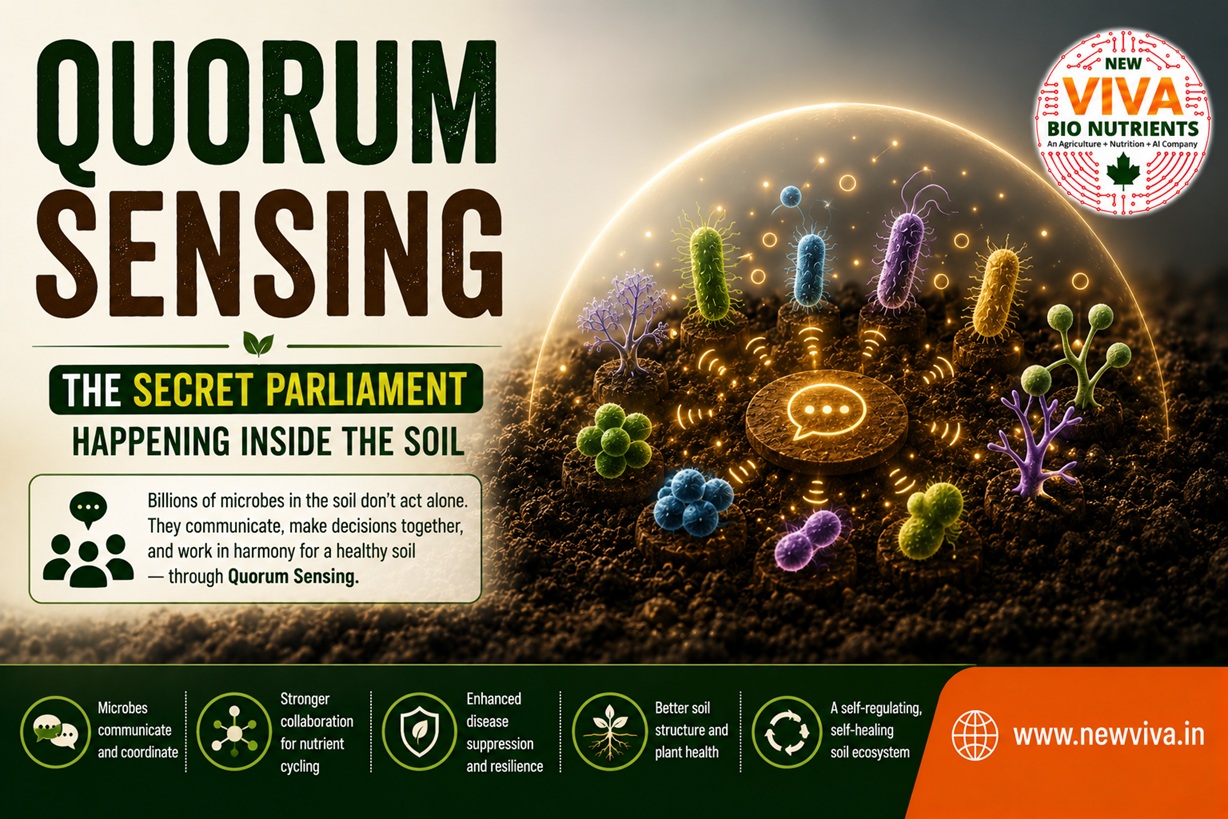
That's why bacteria have figured out a trick. Each cell continuously releases a small signal molecule (like a drop of ink we put in water). This is called an "Autoinducer". The higher the bacterial population, the more that signal molecule accumulates in the surrounding soil moisture. Through their chemistry, they are constantly calculating the number of neighbours they have!
The moment that signal level crosses a certain threshold — that is, when they reach "we are now enough in number to take action" — every cell in that group turns on the same gene at the exact same time, like a parliament unanimously passing a bill. That simultaneous switch-on event is quorum sensing.
Here's how you can understand it.. your enemy comes in front of you. If you are alone, you will feel fear. But at the same time, if you have ten people with you, you gain mental courage. The same wonder is happening inside the soil. That courage is called "Quorum Sensing".
2. Why is this important for your root zone?
This collective decision is what transforms a handful of individual microbes into an organized army working for your crop. Once quorum is reached, that bacterial community around your root tip will:
- Build a Biofilm Fortress: They produce a sticky glue and attach themselves as a protective layer around the root — a living shield that pathogens cannot break through.
- Produce Enzymes Together: Dissolving locked-up phosphorus or potassium in the soil requires a lot of enzyme power. A single cell cannot do this. As a quorum, they do it all at once.
- Switch on Induced Systemic Resistance (ISR): Once they are confident there is enough protection in the group, they send a chemical signal through the root to the crop — turning on the crop's own immune system even before pests or diseases arrive.
- Coordinate Nitrogen Fixation: Both nodule-forming and free-living nitrogen microbes also need this power. They turn on the nitrogen fixation process only when the community reaches a stable population — what's the point of fixing nitrogen if there aren't enough of you to share with the crop?
This is the deeper meaning of what Dr. Christine Jones and Dr. James White said, which we discussed in the last post: the rhizophagy cycle is not just about feeding the crop — it is about seeding that population itself, and that population is what will later reach quorum and govern the root zone.
3. The Chemical Conspiracy: Breaking the Parliament Before It Assembles!
Now see how much indirect damage our chemical habits are causing — most farmers cannot even see this with their eyes.
- Population Collapse: Every time you pour pesticide, fungicide, or excessive urea into the soil, it doesn't just kill the "bad" microbes — it destroys the entire bacterial population around the root. The count drops below the threshold. The signal molecule never accumulates. Quorum can never be reached.
- Parliament Never Meets: Without quorum, the biofilm shield won't form, the enzyme work won't happen together, and the ISR signal won't reach the crop. Every surviving cell turns back into a weak, individual cell — even if some bacteria technically stay alive in the soil, they remain silent without their political conversation.
- Disease Enters Directly: Without the biofilm fortress and without immune priming, when a fungus or pathogen enters the root zone, it enters without any resistance. This is why a disease that a healthy organic field laughs off, destroys a heavily sprayed field overnight — that soil never reaches quorum at all.
The Population Strategy We Must Build (The Takeaway)
The secret behind every "healthy black soil" that you admire is this: it may be healthy due to incredible microbes. The reason is that the population density of good microbes around each root stays high enough, day after day and season after season, to reach quorum.
So the real question arises: between two crop cycles, when your land lies fallow, what do you feed it so this population doesn't collapse below quorum? This is where Cover Cropping becomes a necessity.
A single crop's root exudes only one type of root exudate — one sugar type, one signal type. Bacteria that need a different "menu" starve and die, and your soil's microbial world shrinks year after year. That is why a green manure crop should never be just one or two crops. You need at least 4 to 8 different Plant Families — a grass type (maize or millet), a legume type (sunhemp, flat bean, or daicha), a brassica (mustard or radish), a broadleaf (sunflower or finger millet) — all together. Each family's root speaks a completely different language and feeds a completely different set of bacteria and fungi. The more plant families are sown together, the more varieties of quorum-sensing conversations happen simultaneously inside the soil — that world is not just soil conservation, but real soil health, real soil fertility.
But growing a cover crop is only half the work. The timing and method of terminating it are equally important:
- When to terminate: The right time is when the fastest-growing crop in your mix is at flowering stage — generally within 45 to 60 days of sowing, before any plant sets hard seed. At flowering, the plant's tissue still has a low carbon-to-nitrogen ratio, so it decomposes quickly in the soil and releases nutrients, rather than locking up for months.
- How to terminate: Don't burn it, and don't use herbicides — both are indirect quorum-killers that destroy the microbial population you spent two months building. Instead, use mechanical methods: crimping or rolling (bending and pressing the plant at the base without uprooting it), cutting and laying it down, or as a last resort, lightly mixing it into the soil with a rotavator; if you have the option, letting animals graze it also works.
- Why this method matters: When you crimp or cut without burning or spraying, the root system continues to die off in place. Those decomposing roots become an immediate food source rich in sugars and proteins for the soil's bacterial population, helping to maintain quorum until the next crop's roots pick up the conversation.
If you do this, a cover crop is not just a "filler" between two cash crops. It is a bridge that keeps your soil's parliament continuously in session — never letting the population drop to a point where it gasps for air.
What we should understand from this is.. if you let the soil lie bare and dry out, you are starting again from zero. There is no benefit in killing the life in the soil and repeatedly adding compost. Let's get used to keeping the soil covered 365 days a year.
We'll talk more.