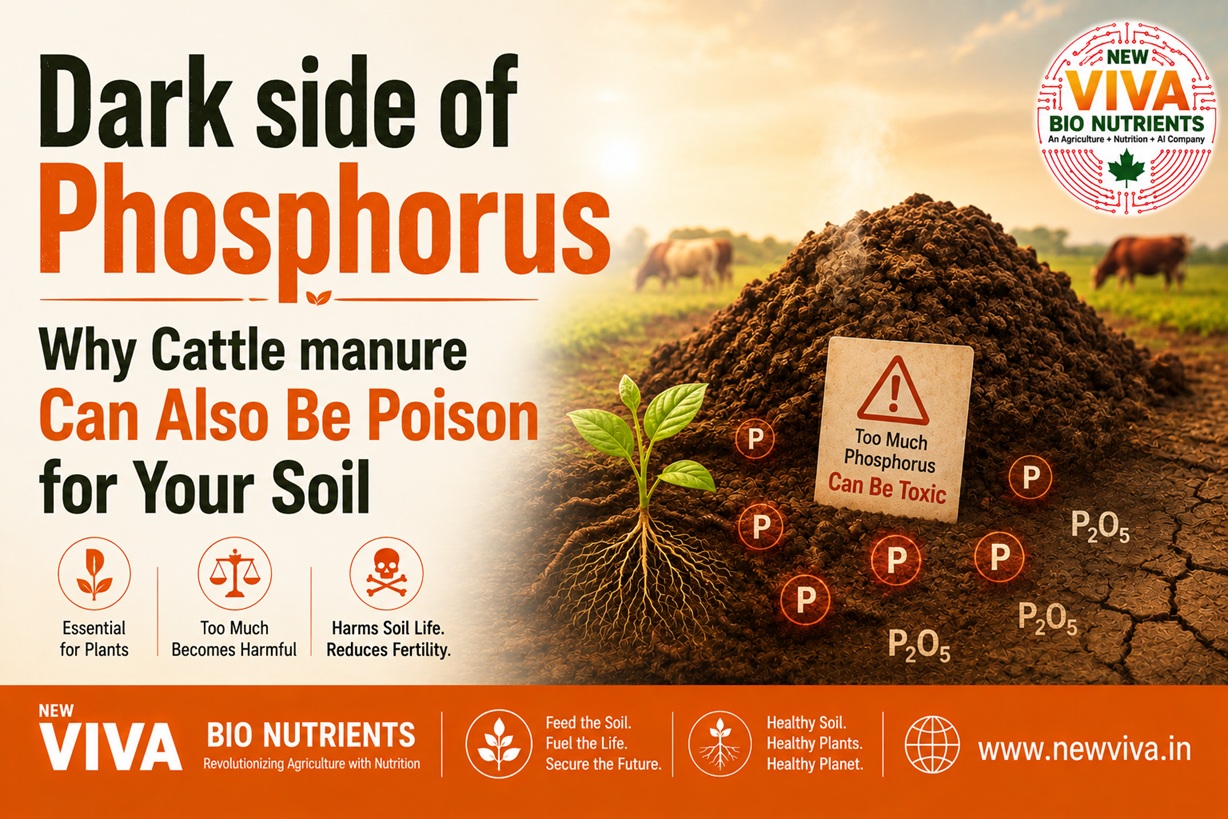
VV-040: Dark side of Phosphorus - Why Cattle manure Can Also Be Poison for Your Soil
In natural and organic farming, farmyard manure and cow dung compost are often seen as sacred materials without any flaws. The common belief among most farmers is: "The more manure we apply to the land, the better."
However, when we closely examine soil test reports from lands that have been under organic farming for many years, a dangerous truth emerges: Severe Phosphorus Overload.
We can see that many farmers who have applied tonnes of cow dung compost for years suddenly face issues like yellowing of leaves, stunted growth, and micronutrient deficiencies in their crops.
The reason for this is: Excess phosphorus!
The reason I am writing this article is also due to a soil test report I came across. This is a land that has been under organic farming for many years.
For privacy reasons, I am not providing the full table here. Only one piece of information from that report is the basis of this article:
- Phosphorus level in that report - 133 ppm
When phosphorus is already high in the soil, applying more and more cow dung compost will completely destroy the beneficial fungi in the soil and starve the crops!
1. The N:P Mismatch in Manure
Why do manure-based fertilizers load the soil with excess phosphorus? The fundamental reason is the difference between plant physiology and manure chemistry:
- Crop Requirement: The average ratio at which a crop takes up Nitrogen (N) and Phosphorus (P) is 5:1 to 10:1 (i.e., for 1 part phosphorus, 5 to 10 parts nitrogen are needed).
- Content in Manure: However, in cow dung, goat manure, and poultry manure, this ratio is only around 1:1 or 2:1.
Nitrogen may evaporate into the air or get washed away by water. But phosphorus does not easily leave the soil. So, every time you apply manure, phosphorus keeps accumulating in the soil like a poison.
2. How Excess Phosphorus Kills Mycorrhizal Fungi
As we saw in records VV-036 and VV-029, we have seen how important Mycorrhizal fungi (AMF) are in transporting immobile micronutrients from the soil to the roots.
Plants grow these fungi by paying them carbon sugars through root exudates, specifically to extract insoluble phosphorus and zinc from the soil.
But when phosphorus levels in the soil rise too high:
- Switch-Off: Once the root tip senses that excess phosphorus is freely available, the plant changes its engine.
- Hormone Cessation: The roots immediately stop secreting Strigolactone signal hormones that attract fungi into the roots.
- Starvation of Fungi: The plant completely stops supplying the carbon food that it used to give to the fungi.
The excess phosphorus in the soil tells the plant, "We no longer need fungi." As a result, the mycorrhizal fungal network collapses, and the soil reverts to a primary bacterial dump!
3. Zinc and Iron Lock-up
Phosphorus toxicity is not directly visible; it attacks indirectly by locking up other micronutrients:
- Zinc Lock-up (P-Zn Antagonism): When phosphorus increases in the soil, it combines with the zinc present in the soil to form water-insoluble Zinc Phosphate. Without zinc, leaves become smaller, and tillering is significantly reduced.
- Iron Deficiency: Similarly, phosphorus also traps Iron, causing young leaves to lose chlorophyll and turn pale.
The Crucial Rule: When Should You Stop Compost?
Fixing phosphorus-toxic soil is a very difficult task. Because phosphorus cannot be flushed out by watering. It has to be absorbed only through crops.
🚫 The Agmark Rule of Regenerative Agriculture
If the phosphorus (Olsen P) level in your soil test is above 25 PPM:
🛑 Act immediately:
Stop applying cow dung, poultry manure, and dung-based composts to the land for the next 1 to 2 years!
What should be done during these 2 years?
- Manure-free multi-species cover crops: Grow crops like mustard, maize, and lemongrass without any manure, and plough them back. These will quickly absorb and balance the excess phosphorus in the soil.
- Only plant-residue carbon: Avoid manure; apply only sawdust, straw, or biochar mixed with humic acid as food for fungi.
- Foliar zinc spray: Since phosphorus has locked up zinc in the root zone, spray zinc and iron mixed with fulvic acid through the leaves to fill the gap.
The truth is that in that report, the organic farm land cannot support large-scale crop cultivation. It will take at least 5 to 7 years to restore it.
Compost is a medicine; do not turn your land into a garbage dump to be poured over. Get a soil test; if phosphorus is above 25 ppm, put a ban on manure!
We'll talk more.
Ravishankar Karuppiah
New ViVa Bio Nutrients
www.newviva.in
934 204 9144