Join our WhatsApp group here -> https://chat.whatsapp.com/DtRfcPrnZykIfmavZU6kj0
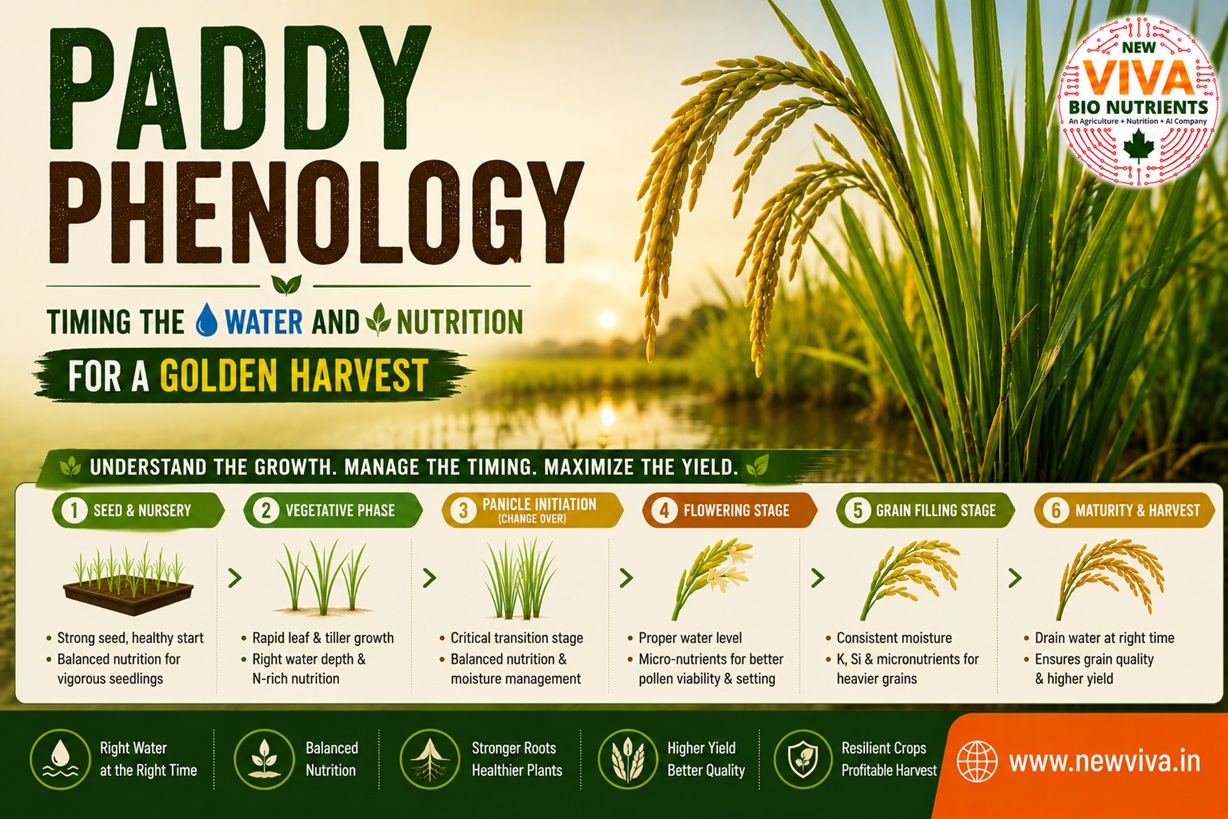
VV-027: Paddy Phenology — Timing the Water and Nutrition for a Golden Harvest
If you look in our Delta districts or other rice-growing areas, farmers keep water logged in the field from transplanting until harvest. If the leaves turn slightly light green, they immediately go and pour urea. There is a common notion that rice needs only unlimited water and nitrogen.
The rice crop is an incredible biological clock. It lives by dividing its lifespan into various precise seasons. In each phenological phase, its water requirement and nutrient requirement change drastically. If you keep water logged in the field always, or if you apply nitrogen heavily during flowering... the grain size will shrink, and you will invite severe Blast disease and stem borer pests, turning your paddy into chaff!
This is the same as mentioned earlier. Just because we say a particular nutrient is needed does not mean other nutrients are not required for that season. We should understand that those particular nutrients are needed in larger quantities. Proper soil testing is also very important here.
Now let us look at this climate blueprint of rice to take your yield to the maximum limit.
Phase 1A: Germination Vigor & Nursery Season (Days 1 to 20 — The Foundation)
- What happens: The Rhizophagy cycle is activated right in the seed coat, roots emerge, and the first leaves appear. In the nursery, the crop's only goal is to strengthen its cellular structure.
- Nutrients required: This early stage is driven by Phosphorus and Zinc. Phosphorus provides energy for root cells to divide and grow rapidly; Zinc activates enzymes for healthy sprouts to emerge.
- Water Management: Keep the nursery moist at all times, but do not submerge it. At this young age, too much water will restrict air to the roots, slowing root growth and reducing the vigor of the seedlings.
The Most Critical Turning Point: Why Transplant at the Right Time Before Tillering Begins?
The overall profit of your rice cultivation lies in this single decision. Tillering is the process where the crop sends out lateral branches from its base — from each of these tillers, large panicles will later form.
According to the rice crop's biological clock, it begins to tiller within 20 to 25 days after sowing. Before this timing clock strikes, you must have uprooted the seedlings from the nursery and transplanted them into the main field!
If you leave the seedlings too long and transplant them as old, coarse seedlings (for example, on the 35th or 40th day)... the plant will experience a severe "Transplant Shock" at the exact time it should be tillering. The roots get damaged, hormone balance shifts, and the plant's tillering ability becomes severely stunted. Such late-transplanted crops will have lower yields and weaker plants. But if you transplant them as young seedlings when the plant is at the 3-4 leaf stage (that is, within 18 to 20 days)... the crop's yield and strength will be much higher!
Phase 1B: Active Tillering Phase (Days 20 to 60 — The Yield Factory)
- What happens: Within 5 days of transplanting into the main field, the seedlings establish roots and immediately begin sending out lateral tillers. The overall productive capacity of your field is prepared here.
- Nutrients required: Balanced Nitrogen and Zinc. Nitrogen promotes vegetative growth, but the number of tillers will reach maximum only if Zinc is also present.
- Water Management (AWD — Alternate Wetting and Drying): During this tillering phase, rice should not have standing deep water. Excessive stagnant water suffocates the base of the plant and actually prevents lateral tillers from emerging! Immediately after transplanting, keep only 1-2 cm of light water for root establishment. After that, let the water drain naturally and allow the field to dry until fine hairline cracks appear in the soil. Then irrigate again. This makes roots grow deeper into the soil searching for water, anchoring the crop firmly like a stronghold. This also helps prevent lodging during harvest.
Phase 2: Reproductive Phase / Panicle Phase (Days 61 to 90 — From Panicle Initiation to Flowering)
- What happens: This is the most critical transformation phase that determines the crop's life. Inside the rice stem, the panicle now begins to form secretly (Panicle Initiation). Then comes the Booting stage, followed by panicle emergence and flowering.
- Nutrients required: Please reduce Nitrogen (urea) during this time! This phase is entirely governed by Silicon, Calcium, Potassium, and Boron (Silicon, Potash & Boron). Silicon hardens the leaves and stems like iron, creating a glass-like armor; because of this, Blast disease and stem borer cannot bore into the crop. Boron is extremely critical during flowering to ensure every grain in the panicle fills 100% without any chaff.
- Water Management (Critical Water Phase): You can let the field dry during the vegetative phase, but during this panicle phase, the field must not dry out even a drop! From panicle initiation until flowering is complete, if rice experiences water deficit, the yield will be empty. During this time, the field must always have 3-5 cm of continuous standing water. If the field dries out during this time, pollination will be affected, and the entire field will turn into white panicles (chaff), causing heavy loss.
Phase 3: Maturity Phase / Grain Filling Phase (Days 91 to 120 — Panicle Maturity)
- What happens: All flowers are fertilized, and now the panicle fills with milk (Milky stage). That milk then gradually hardens into the dough stage (Dough stage), and finally becomes a well-hardened golden rice grain.
- Nutrients required: This stage is fully controlled by Potassium and Magnesium. Magnesium is needed to keep the Flag leaf dark green without drying; Potassium acts like a train to transport all the starch produced and pack it into the grain, giving the rice a plump, heavy weight.
The Harvest Moisture Control
When should water be stopped before harvest? This is the final test for an excellent rice farmer!
- Rule: 10 to 15 days before your harvest date, you must completely drain the water from the field and let the land dry.
- Why? Only when the water is drained does the plant transfer all its remaining energy into the grain, helping all the rice in the field ripen uniformly. This brings the moisture content of the grain to the ideal level of 18% to 21%.
- If moisture is too high (above 22%) at harvest, the rice will break during milling, and procurement centers will also reject it. On the other hand, if it dries too much (below 16%), the grains will shed right in the field, and the rice will develop cracks, causing losses.
This moisture secret is very important to prevent grain shedding and wastage during machine harvesting.
What We Must Understand:
Rice is not just some grass growing in a field; it is a highly precise and incredible plant. Transplanting seedlings at a young age, practicing Alternate Wetting and Drying to deepen roots, maintaining standing water during the flowering phase, stopping urea and applying Silicon/Boron during flowering, and draining water two weeks before harvest — if you adopt these methods, 30% water will be saved, there will be no need for fungicide sprays, and the grains will become nice and heavy! If you raise the rice crop robustly, there will be no work for pesticides. Don't farm by just looking at a calendar; look at the rice crop's biological clock climate and provide the nutrients it needs accordingly!
We'll talk more!
Ravishankar Karuppiah
934 204 9144