Join our WhatsApp group here -> https://chat.whatsapp.com/DtRfcPrnZykIfmavZU6kj0
VV-029: The Fungal-to-Bacterial (F:B) Ratio — The Soil Evolutionary Clock
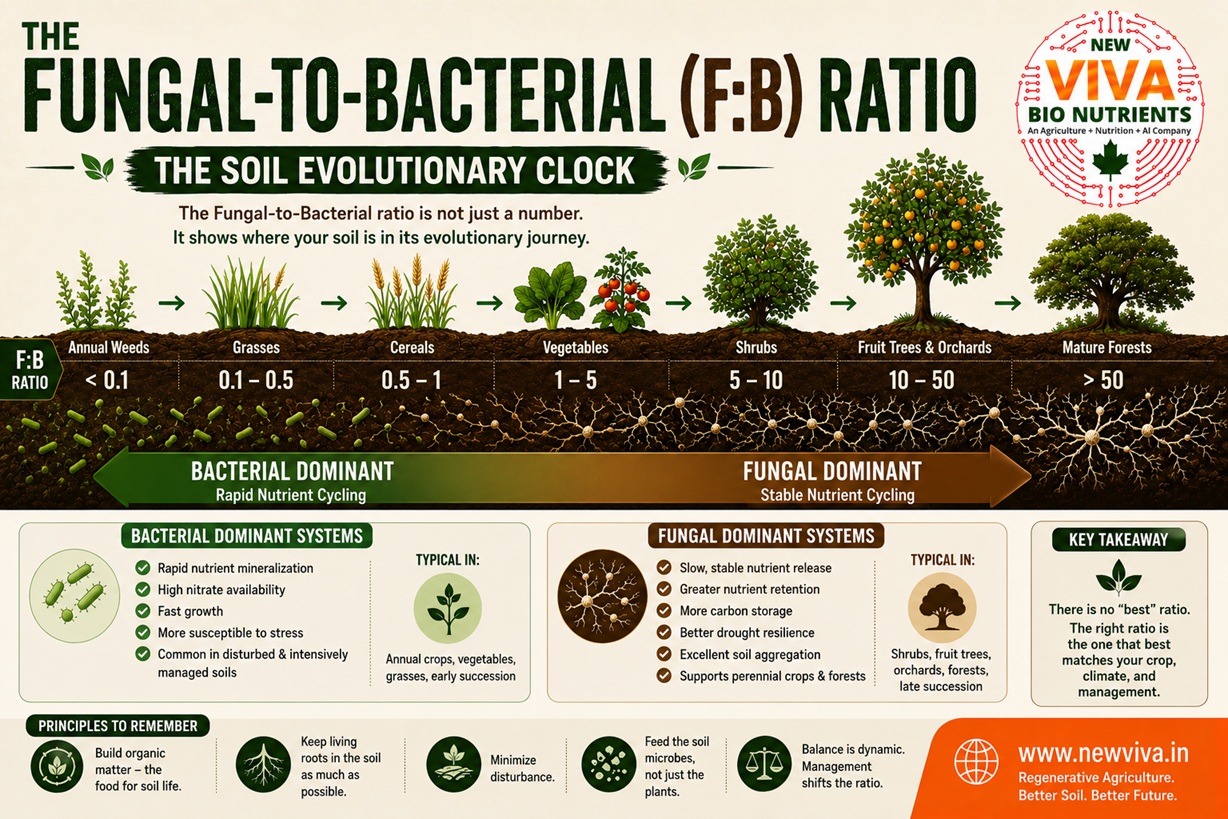
Most farmers measure soil fertility only by using chemical bags—they only look at how much NPK is in the soil. But if you want to understand why weeds are overgrowing like a forest in one field, while at the same time trees in your neighbor's grove are growing lushly... you need to look at the soil's secret biological clock: that is the Fungal-to-Bacterial / F:B Ratio.
The microorganisms inside the soil are not always the same; they are continuously undergoing evolutionary development. For many thousands of years, nature has been slowly evolving its soil from bacterial dominance toward fungal dominance. As this F:B ratio changes, the soil's chemistry also changes; because of this, nature's DNA decides which type of crop should germinate in that soil.
If you take a tree that asks for fungal nutrients and plant it in dry land that has only bacteria... even if you pour bags and bags of fertilizer, it will not grow. Let us now clearly see this biological wonder without any confusion, using our region's 5 major crops.
The Ladder of Soil Evolution — and the Target of Crops!
Imagine the F:B ratio as nature's ladder. At the very bottom of this ladder is land that has been heavily tilled, damaged with chemicals, and left bare. Here there are no fungi at all; only bacteria rule (F:B < 0.1:1). Bacteria hold nitrogen in the nitrate (NO_3^-) form. This nitrate smell is the secret switch that triggers weed seeds to "sprout, come on!"
When there are continuously living roots and mulch in the land, fungi begin to build their network inside the soil. Fungi convert nitrogen into ammonium (NH_4^+) form. For every crop we grow, according to its genetics, there is a specific target. Without any confusion, here are the ultimate target numbers we need to reach for each crop:
1. Small Onion (Target F:B Ratio — 0.6:1)
Onion is a short-duration, shallow-rooted, low-growing crop. It sits a little lower on the evolutionary ladder. It needs soil with a slight bacterial bias for quick nutrient availability. But it also needs some fungi to dissolve minerals; therefore, a ratio of 0.6:1 is just right for it.
2. Paddy Rice (Target F:B Ratio — 1:1)
Rice is a very advanced grass-type plant. Although paddy soil in chemical fields has been turned into a bacterial mess, if you want to reach its full genetic potential and get maximum yield... it definitely needs a precise balance of 1:1 where fungi and bacteria are equal. Bacterial speed is needed for tillering; at the same time, fungal strength is needed to prevent rice blast disease and keep the stem strong.
3. Banana (Target F:B Ratio — 2:1)
Banana is a giant, thick, seasonal grass-type plant! It needs bacteria to rapidly convert the enormous nutrients it drinks daily, and at the same time, to keep the stem strong and prevent the deadly Panama Wilt disease, it definitely needs a fungal level of 2:1.
4. Coconut Tree (Target F:B Ratio — 10:1)
On the evolutionary ladder, the perennial coconut tree is the next higher level. In nature, coconut fronds and the coconut husks that fall in heaps are rich in strong lignin. To decompose this thick waste, a special fungal army is needed. For good yield in a coconut grove, there must be a fungal dominance of 10:1 there. Only then will the roots run deep and long, holding water even during drought.
5. Mango Tree (Target F:B Ratio — 50:1)
Perennial trees like mango are native plants born and raised in the forest! Their roots do not like the fizzy nitrate food that bacteria provide. They need a gigantic 50:1 fungal empire to have formed underground. It is these extraordinary fungal networks that dissolve the locked-up phosphorus in the soil, extract micronutrients, and bring good Brix weight to the mangoes!
The Truth the Farmers Must Understand:
Why are weeds sprouting uncontrollably in our fields today, and why do diseases keep coming? Because... the deep plowing we do, the chemical poisons we apply, and drying out the land—all of this cuts and destroys the fungal networks in the soil, turning it back into a primitive bacterial state!
If you take a rotavator and plow deep inside a mango grove or a coconut grove, or if you pour chemicals in a paddy field... you are killing the fungi there, turning the evolutionary clock backwards, and rolling out a red carpet to welcome weeds and diseases yourself!
Stop treating the soil like a lifeless chemical bowl. Understand your crop's biological target. Throughout the year, build up your soil's fungal army through living roots, diverse cover crops, and mulch. Match the biology to the crop, and then see how nature runs your farm by itself. True natural farming starts right here!
We'll talk more!
Ravishankar Karuppiah
New ViVa Bio Nutrients
www.newviva.in
934 204 9144