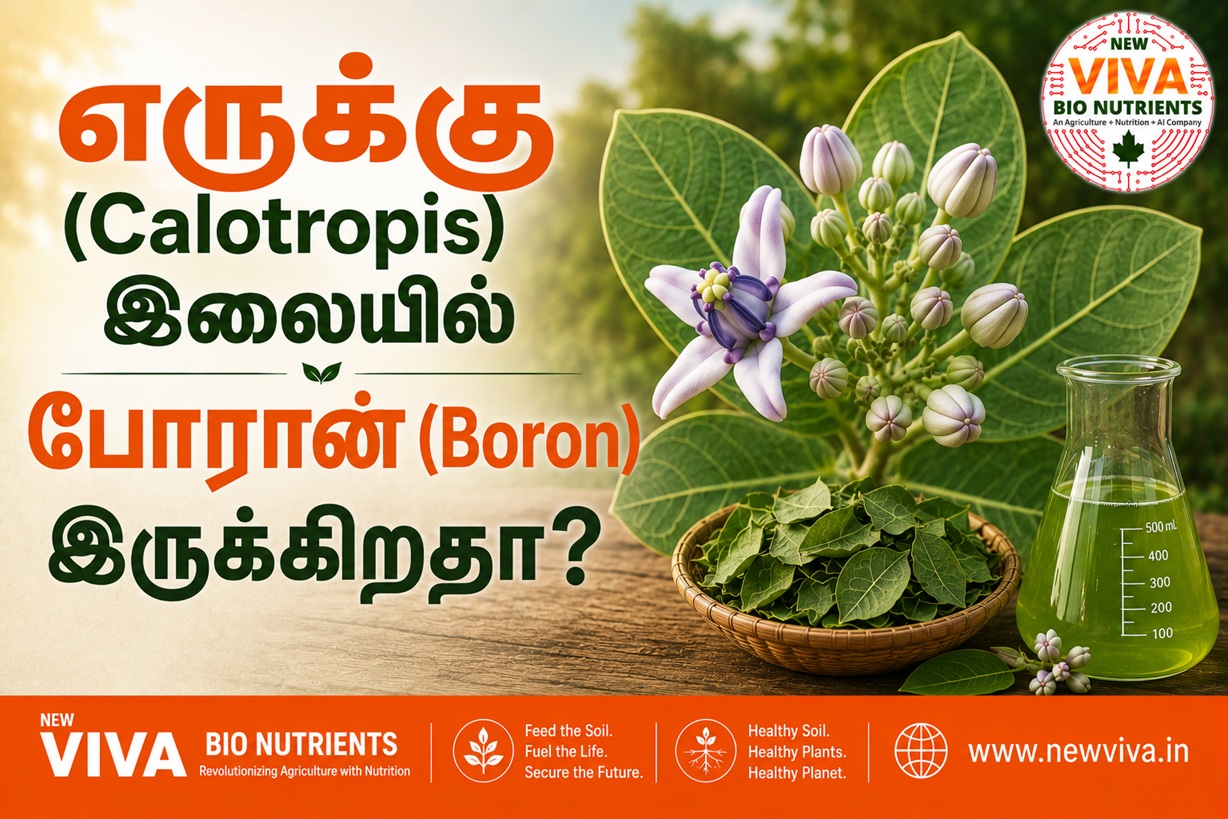
VV-033: Does Erukku (Calotropis) leaf really provide Boron nutrition to plants? The scientific truth behind the Natural farming claim!
If you have travelled in the natural farming circles of Tamil Nadu, you would have definitely heard this one thing repeatedly: "Calotropis (Calotropis gigantea) leaf has very high boron content. If used as mulch, green manure, or as a solution, it can completely correct boron deficiency in crops."
This opinion is being repeated with great confidence in agricultural seminars and social media.
Our main objective in Regenerative Agriculture is to compare traditional agricultural knowledge with systematic plant science. In that context, when I started searching for scientific research behind the question "Does Calotropis contain boron?", an important gap that we need to discuss emerged.
What do the research results actually say?
Many international and Indian research papers have analyzed what minerals and chemical components are present in Calotropis leaf through modern technologies such as X-ray Fluorescence (XRF) and Atomic Absorption Spectrometry (AAS).
In all these studies, a particular mineral composition repeatedly appears in the same pattern:
- Potassium (K), Calcium (Ca), and Chlorine (Cl) occupy up to about 20% of the dry weight of Calotropis leaf.
- Magnesium (Mg), Iron (Fe), and Zinc (Zn) are present in smaller amounts.
- Boron (B) does not appear in any mineral analysis at all! There is no data on whether it is high or low. In short, no one has specifically tested how much boron is present in Calotropis leaf so far (Not Tested).
Most research related to Calotropis focuses on its medicinal properties and pesticidal chemicals (Flavonoids, Cardenolides), but no specific study measuring boron content from an agricultural perspective has been published to date.
Let me also mention this. I asked this very question—whether Calotropis leaf contains boron—to the Tamil Nadu Agricultural University - Natural Farming Research Station team as well. Their response was: "This is traditional knowledge." They had no other data beyond that.
So, is this claim wrong?
It cannot be said that this is a wrong claim—but it must be said that it is an "Unverified Claim."
"A thing being tested and proven false" is different; "it has not been tested at all" is different! The talk about boron in Calotropis falls into the second category.
We need to understand why this belief arose according to plant science:
- All plants contain small amounts of boron: Boron is a fundamental micronutrient required for building plant cell walls. All green leaves on Earth contain small amounts of boron. So, Calotropis leaf also contains boron—the same amount of boron would be present in a mango leaf or an ordinary weed as well.
- "Presence of boron" is different; "being usable as boron fertilizer" is different: For a plant to serve as a fertilizer that can correct boron deficiency in another crop, it must be a "Hyper-accumulator" that stores boron in large quantities. There is no botanical evidence that Calotropis leaf is such a boron-accumulating plant.
- Confusing the plant's vigour with nutrient content: Calotropis is a very vigorous plant that can tolerate drought and saline soils. Seeing Calotropis thriving even in wastelands where crops do not grow, farmers have mistakenly assumed: "It absorbs and stores special minerals from deep within the soil that other plants cannot extract, which is why it contains boron." Tolerating drought and storing specific nutrients in tissues are two entirely different botanical characteristics!
What benefit does this have for farmers?
If you are using Calotropis leaf as mulch, green manure, or in pest-repellent solutions (such as five-leaf solutions), please continue doing so freely!
Calotropis leaf has excellent scientific contributions in providing organic matter to the soil, recycling general minerals, and controlling pests. Using Calotropis leaf as green manure in paddy fields is a traditional method that has been successful for generations.
But if you have confirmed boron deficiency in your land through testing and are solely relying on Calotropis leaf to correct it... that is merely an unsupported assumption!
If soil testing confirms boron deficiency, use precisely measured methods:
- For immediate crop relief: When spraying Solubor or Borax fertilizers along with Fulvic Acid, boron is directly available to the crop without getting locked up.
- For soil fertility enhancement: Add well-decomposed compost along with biological fungi that release nutrients in the soil.
Plant Physiology Barrier: Boron Mobility within Crops!
Even if we assume that Calotropis leaf contains a small amount of boron, we encounter an important physiological barrier from a plant physiology perspective: Boron mobility within plants!
In most crops (including paddy, vegetables, and fruit trees), boron is a Phloem-immobile nutrient. That means, once boron enters a specific leaf of a plant, the plant cannot translocate it to newly emerging shoots or flowers.
- Limitations of Foliar Sprays: When you spray a boron-containing solution through the foliage, that nutrient is available only to the leaf on which the liquid lands. A few days after spraying, this nutrient will not move from below or from the sides to newly forming young shoots, flowers, or roots.
- Importance of root uptake: For a crop to receive uninterrupted boron throughout its life—from root development to flowering and fruit formation—the roots must continuously absorb the nutrient along with water from the soil (through the Xylem pathway).
This is why spraying unverified leaf juices like Calotropis leaf alone cannot completely correct boron deficiency in the soil. If your soil lacks boron, no matter what you spray on old leaves, the newly emerging shoots and flowers will continue to suffer from boron deficiency!
I plan to write an article about this. We also need to understand how each nutrient moves within a crop. Only then will we gain clarity on how to correct nutrient problems. We can look at that in the coming week.
The lesson Regenerative Agriculture teaches us
This is an excellent example of an important thing we need to be cautious about in natural farming: Traditional talk about a plant spreads faster than its actual scientific measurements.
This does not mean traditional farming is wrong—most of its aspects are scientifically valid. But if a farmer asks, "Will Calotropis leaf provide boron to my crop?", the honest scientific answer is: "We don't know—no one has measured it in a laboratory so far!"
As we saw in WA-007, according to Liebig's Law of the Minimum, even if you have provided the required amounts of nitrogen, phosphorus, and potash to your crop, if boron is only at half the required level—your yield will decrease by half. You will not find this in any natural farming book today. But nature works with a clear structure. Implementing that with the support of science is Regenerative Agriculture.
Note - Please share this with all the farmers you know and in farming groups. Regenerative Agriculture is our future. Let us journey together. Thank you.
Some important research articles about Calotropis can be found at the following web addresses:
We'll talk more.
Ravishankar Karuppiah
New ViVa Bio Nutrients
www.newviva.in
934 204 9144