🚜 Why Farmers Struggle to Move Away from Chemical Farming
There are two main reasons why farmers find it difficult to transition from chemical farming:
- Weeds – Uncontrolled weed pressure that reduces yields
- Nitrogen management – Fear of insufficient nutrition for crops
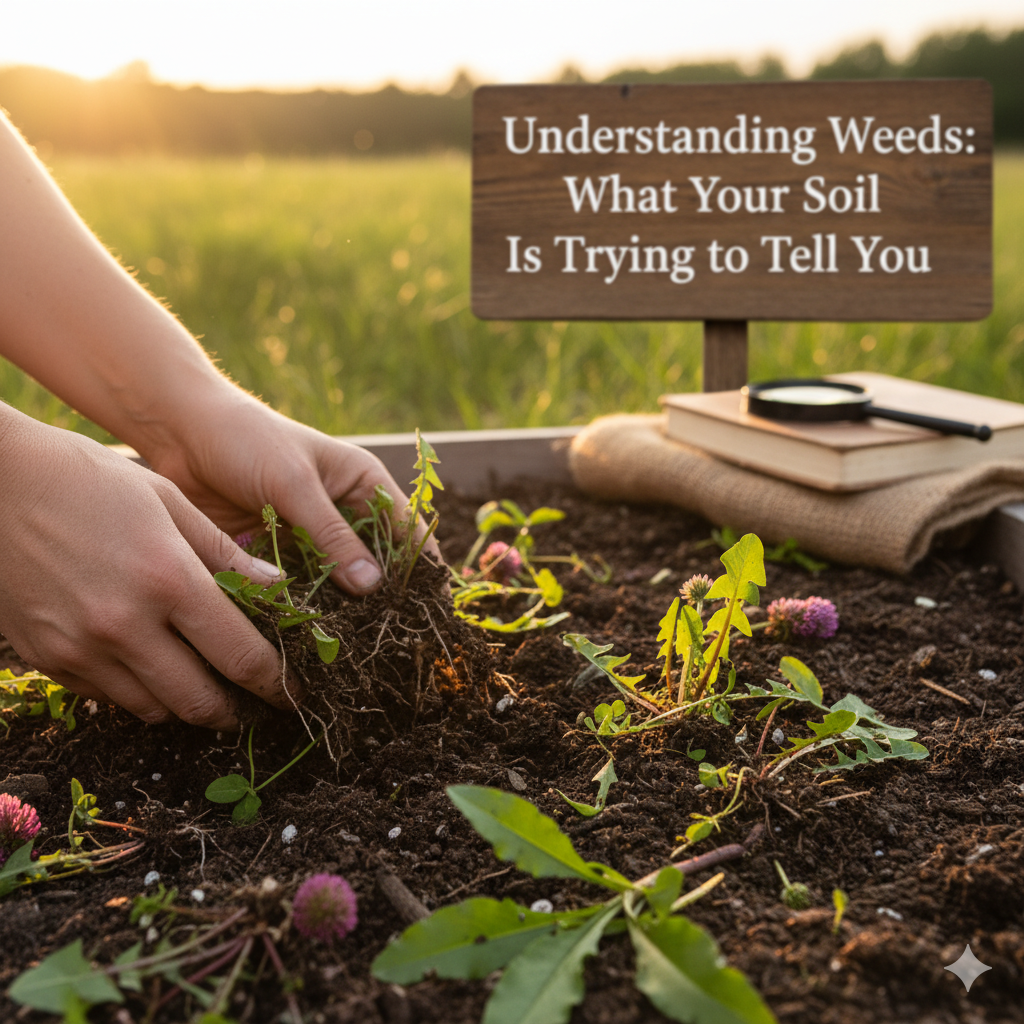
In this blog, we'll focus on weeds and how understanding them can transform your farming practice.
⚠️ The Reality Check: Why Organic Farming Adoption Remains Low
The organic and natural farming movement often focuses on the "good vs bad" debate. But it rarely addresses the core question: How can a farmer make a living?
Farmers need practical solutions, not just ideologies. If an alternative farming method cannot guarantee:
- Yields comparable to chemical farming
- Effective weed control
- Consistent income
...then farmers will naturally hesitate to adopt it.
💡 The Challenge
Many farmers who try organic methods struggle with practical realities on the ground. Without science-based solutions for weed and nutrient management, even well-intentioned farmers find it difficult to sustain organic practices beyond a few years.
🌿 What Are Weeds, Really?
"Weeds are plants making scarcely more than vegetative growth on soils too low in fertility for other kinds of plant growth."
— Dr. William A. Albrecht, Soil Scientist
In simpler words: Weeds are mineral collectors. They grow in soils that lack the proper nutrition for your desired crops. When these weeds die and decompose, they add minerals back to the topsoil in a form that subsequent plants can use.
Two Different Perspectives:
🧑🌾 From a Farmer's Viewpoint:
Weeds are unwanted plants that compete with cash crops and reduce yields. They must be controlled to maintain productivity.
🌍 From Nature's Viewpoint:
Weeds are nature's way of healing and balancing the soil. They grow because the soil needs them to correct an imbalance.
🔑 Key Understanding
A weed is simply a crop that the soil thinks ought to grow, while the farmer thinks it ought to be removed. Understanding why the soil "wants" these weeds is the first step to controlling them naturally.
🔬 Why Does Your Soil Grow Weeds?
Problem #1: Excessive Urea Usage (Chemical Farming)
In chemical farming, farmers use large amounts of urea. Here's what happens:
The Urea Cycle:
-
Urea is a nitrogen 'salt' fertilizer. In soil, it converts to nitrate nitrogen and combines with calcium to form calcium nitrate.
-
Calcium nitrate is highly mobile and leaches out (washes away) with water, taking valuable calcium away from your soil.
-
Loss of calcium creates a calcium-to-magnesium imbalance in the soil.
-
This imbalance, combined with moisture loss from salt's heat-generating properties and heavy tillage, creates hard pan – a compacted layer in the soil that is not conducive for life.
Nature's Response:
Nature responds to hardpan by growing grass weeds. Why? Because these weed roots can penetrate through the hardpan and break it up, helping to restore balance.
⚡ Important Indicator
If you have increasing grass weeds that are difficult to control, it indicates:
- You're using too much salt-based fertilizers, OR
- Your soil's mineral balance is not optimal
The solution is not more herbicides – it's fixing the soil balance.
Problem #2: Excess Potassium in Organic Farming
In organic and natural farming, we often apply large quantities of compost and manure. While these seem natural and safe, there's a hidden problem: they are very high in potassium.
What happens:
- When potassium levels are very high in soil, it "crowds out" calcium
- This creates a nutritional imbalance
- Nature fixes this imbalance by introducing weeds
The Real Issue:
Weeds cannot be controlled unless the soil nutrition imbalance is corrected. Since organic farming often doesn't rely on soil testing and mineral balancing science, farmers are never taught how to fix this issue – even though the science exists to manage it.
🌼 Case Study: The Dandelion (Taraxacum officinale)
What Dandelions Tell Us About Your Soil
From the book "When Weeds Talk" by Jay L. McCaman:
Dandelions are excellent indicators of calcium-potassium imbalance. Here's what research has shown:
The Problem Scenario:
- Farmers apply 700-800 pounds per acre of potash on alfalfa fields hoping for big yields
- The next year, dandelions appear in large numbers
- By the third year, dandelions have taken over and the alfalfa is done
Why does this happen?
Excess potassium suppresses calcium levels in the soil.
The Solution:
- One farmer applied just 3 gallons of liquid calcium per acre
- Result: A very significant reduction in dandelions in that field
How Dandelions Work:
- Their roots go 3 feet or more deep into the soil
- They bring calcium up from this depth
- When the plant dies and decays, calcium is released into the topsoil
- Carbon and other minerals are also released, improving soil organic matter
📚 The Universal Principle of Weeds
The book "When Weeds Talk" has catalogued nearly 1,000 weed plants (mostly from the US) and studied the soil conditions where they grow.
The Shocking Finding:
Out of 1,000 weed plants studied, 999 were found growing only on soils with Low to Very Low calcium levels.
🎯 Critical Understanding
When we talk about calcium levels, it should not be understood as a standalone value. Every nutrient in the soil should always be understood as a ratio to another nutrient.
Our Indian soils have become depleted of calcium because of:
- Excessive urea usage
- Excessive use of potash fertilizers (including wood ash and manure-based fertilizers)
🔄 The Path Forward
Weeds are not your enemy – they are messengers telling you what's wrong with your soil.
Instead of fighting weeds with herbicides or manual labor alone, we need to:
- Understand what the weeds are telling us about soil imbalances
- Test and balance soil minerals – especially calcium, potassium, and magnesium ratios
- Create an environment where weeds are not needed because the soil is balanced
Coming Up Next
In my next blog, I'll cover Cation Exchange Capacity (CEC) and soil balancing techniques that will help you:
- Control weeds more scientifically
- Improve soil nutrition methodically
- Create a sustainable, environment-friendly farming system
- Reduce your dependence on both chemical herbicides and excessive manual weeding
🙏 Acknowledgment
I want to thank Dr. Uma Devi Akka and Dr. Ramalingam Anna who made this knowledge accessible to me. They sourced the book "When Weeds Talk" by Jay L. McCaman from the US (not available in India) and gifted it to me without accepting any payment. They also provided with another expensive reference book "Mineral Nutrition and Plant Disease" which is considered a bible in Regenerative Agriculture circles (I'll discuss this book too in my future blogs).
It is because of their generosity that I am able to share this science with you. I hope this knowledge helps improve your farming practices.
All thanks to Uma Akka and Rams Anna! 🙏
🌾 Transform Your Farm with Science-Based Regenerative Agriculture
New Viva Bio Nutrients is India's first science-driven regenerative agriculture company. We're not just selling products—we're partnering with farmers to transform Indian agriculture from the ground up.
Why Choose New Viva?
Our approach is different because it's built on soil science, not ideology:
- 🔬 Start with Soil Testing - Get a customized roadmap based on your soil's actual mineral balance
- 🌱 Premium Bio-Inputs - High-quality microbial inoculants and soil amendments designed to correct imbalances
- 👨🌾 Expert Consultation - Ongoing guidance to help you transition successfully and profitably
- 📈 Better Economics - Reduce input costs while increasing crop nutrition and yields
Our Goal is Clear:
We want to make farming in India:
- ✅ More sustainable and profitable
- ✅ More environment-friendly
- ✅ Most importantly—producing most nutritious crops that is possible in farming
This is not just an option. This is the future of farming.
🚀 Ready to Take the Next Step?
Whether you're struggling with weeds, soil health, or want to transition away from chemical farming:
👉 Visit NewViva.in to:
- Get your soil tested and assessed
- Explore our range of bio-inputs and nutrients
- Sign up for personalized farm consultancy
- Read more science-based farming blogs
💬 Have Questions?
Are you facing challenges with:
- Uncontrollable weed pressure?
- Rising input costs?
- Declining soil health?
- Failed organic farming attempts?
Drop your questions through our Contact Form. I'll try to address them in future blog posts or connect you with solutions specific to your farm.
📢 Found this helpful? Share it with fellow farmers who need to know this!
Thank you for reading! 🙏